The article I have selected for discussion is titled "Musk, Mars and the high price of manifest destiny: Adventure can be the only justification for manned space flight". This article, published by the London's Financial Times, discusses the current status of manned space exploration. The article begins by highlighting the slow decline of manned space travel since the cancellation of the 30-year U.S. space shuttle program in 2011. The United States has since relied on the Russians to catch a ride to the International Space Station (ISS) while commercial unmanned space systems deliver experiments and supply to the ISS. Although plans to conduct manned missions beyond low Earth orbit have been laid, its execution is still many years away.
The American public has expressed their own opinions in regards to the direction of the current space program. Some support direct involvement and a leadership role in space exploration while others don't quite see the need for a manned space program. Among the heavy supporters for space exploration is billionaire entrepreneur Elon Musk. Mr. Musk is an open supporter of space exploration and has frequently shared his vision of interplanetary travel. Mr. Musk proposes the design and development of a spaceship that can ferry passengers between Earth and Mars in as little as three months.
The article does not dive into full details on specific modalities for space exploration, but the language and tone used by the author suggest support for unmanned space exploration and opposition to manned space flight efforts. The author of this article believes that the break in space exploration since the end of the space shuttle program should be used to evaluate the need to send people to space, an environment which he calls "so profoundly hostile that huge sums have to be spent making space travel even remotely safe". He also calls the support for manned space travel a "compulsion to spend billions of tax dollars" and refers to Elon Musk's plans as "intoxicating visions".
The author continues his tirade by questioning the feasibility of Mr. Musk's plans alleging that the technology to carry out such plans does not yet exist and that its development would require billions of tax payer dollars. He cites the potential for public discontent and attempts to bring into question Space X's reputation by highlighting the two accidents suffered by Space X early this year. The author alleges that if the money used to fund manned space flight would have been invested in unmanned exploration, we would know far more about space and the universe than we know today.
Although the author is correct in some regards, namely the cost of manned space exploration, I respectfully disagree with his view. There has to be indeed certain level of ambition and adventure, but space exploration is more than that. Space exploration gives us the ability to go above and beyond of what we know. It allows us to answer questions about our universe, and history and gives us the ability to prepare for the future. Many people may share the same view as the author and may feel compelled to cite the space shuttle program which unfortunately did not live up to expectations. The space shuttle program, announced in 1972, was portrayed as a major advance that would allow frequent access of space at an affordable cost. By frequent, NASA cited at least once per week; and by affordable NASA estimated $20 million per trip. As of 2010, NASA had flown 134 flights costing $209 billion. The cost of each flight was about 1.6 billion and the space shuttle never flew more than nine flights in a single year. Although the space shuttle program could be considered a disappointment, using it as an excuse to advocate against manned space flight is rather unfair.
references
Musk, Mars and the high price of manifest destiny. (2016, September 29). Financial Times. Retrieved from http://search.proquest.com.ezproxy.libproxy.db.erau.edu/docview/1833391107?accountid=27203
Wall, M. (2011, July 5). NASA's shuttle program cost $209 Billion: Was it worth it?http://www.space.com/12166-space-shuttle-program-cost-promises-209-billion.html
Sunday, November 20, 2016

Sunday, November 13, 2016
Artificial Intelligence in Unmanned Aerial Systems
This week's blog post is based on an article titled "Unmanned Aerial Vehicles (UAVs) and Artificial Intelligence Revolutionizing Wildlife Monitoring and Conservation". This article highlights the importance and necessity of using unmanned aerial systems' technology to enhance military and civilian applications. This article gives us an insight on how unmanned aerial system technology paired with artificial intelligence can significantly improve current methods in any given operation; in this case, wildlife monitoring.
Obtaining wildlife population estimates can be difficult and time consuming. The most common techniques used to estimate wildlife population include remote photography, camera traps, tagging, GPS collaring, GPS sampling, scat detection dogs, and surveys performed on foot. These techniques can be very inefficient and worse yet, inaccurate. Nevertheless, these techniques have contributed to the protection and conservation of wildlife for many years. Current monitoring techniques are also limited due to low wildlife population densities, large geographic ranges, elusive behavior, inaccessible habitat, and wildlife's sensitivity to disturbance.

The advancement of unmanned aerial systems and artificial intelligence have created a new opportunity to conduct wildlife surveys. Although the use of UAS in wildlife monitoring can be affected by current laws, and public perception. Unmanned aerial systems have demonstrated to be more efficient when conducting these operations than manned platforms. Among the advantages of using unmanned systems is risk reduction, increased safety, lower cost, and reduced logistics, and low disturbance rates. The article describes a study in which unmanned aerial systems are used with advanced detection sensors. The purpose of the study was to achieve automatic thermal object detection, acquisition, classification, and tracking of wildlife in a specified area to obtain a population estimate.
1. Load templates
2. Process templates
3. Search for each template in the video frame
4. Assign coordinates
5. Create a mask using coordinates
6. Logical operation with the mask
7. Pixel intensity threshold
8. Tracking
9. Counting
10. Last frame loop (If the process is unsuccessful, the algorithm re-starts in step three)
The validation test was focused on the detection, tracking, and classification of Koalas, a marsupial specie whose population has been in declined in the last few years. The experiment took place between 7:00 am and 8:00 am, thought to be ideal for the temperature difference in Koala species. RGB video as well as thermal video was acquired using the UAS in autonomous mode which had a predefined mission which commanded it to conduct a lawn mower pattern search.
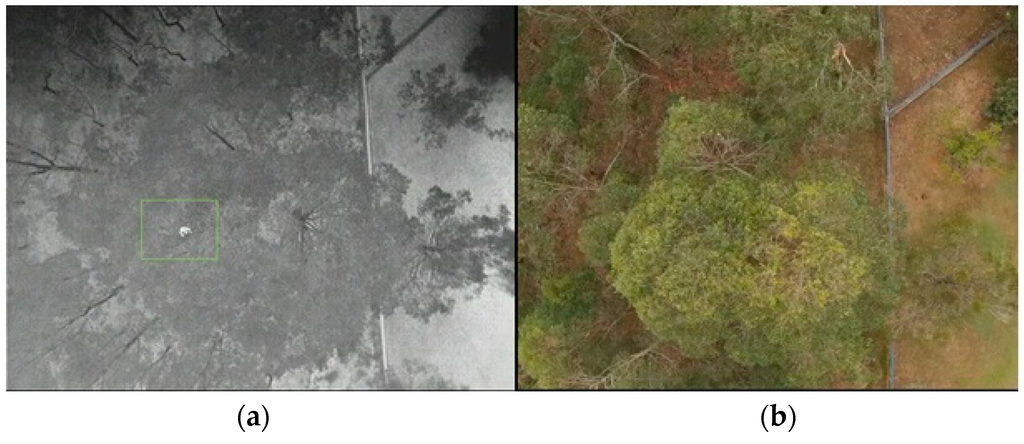
The study was successful in detecting various types of Koala in the specified area. The GPS was able to display the location of all specified targets. This new advanced capability will assist advocates in determining the population distribution and abundance of any species. This will give developers and stakeholders better situational awareness on the impact that new constructions could have on the habitat of endangered species. The algorithms used can be adjusted to meet specifications for any type of animal, for a specific size, and even a specific thermal signature. As you can see, this new technology enhances current processes and provides more accurate population estimates in regards to wildlife conservation.
References
Gonzalez, L., Montes, G., Puig, E., Johnson, S., Mengersen, K., & Gaston, K. (2016). Unmanned Aerial Vehicles (UAVs) and Artificial Intelligence Revolutionizing Wildlife Monitoring and Conservation. Sensors, 16(1), 97. MDPI AG. Retrieved from http://dx.doi.org/10.3390/s16010097
Saturday, November 5, 2016
How Unmanned Maritime Systems Are Shaping the Battlefield
Despite prolonged military conflicts in the past two decades, The United States have seen little action in the maritime stage. This is due to the nature of current conflicts. The latest military interventions have taken place in the middle east, in the desert environment, and against a non-conventional enemy. Things could rapidly change as diplomatic tensions with countries such as Russia, China, North Korea, and Iran continue to deteriorate.
In order to maintain a combat-ready naval force, the United States NAVY continues to develop, test, and advance their combat capabilities. Among the latest initiatives is the NAVY's plan to outfit their littoral combat ships (LCS) with anti-mine mission packages. The plan was revealed last month by the executive director for the Program Executive Office of Littoral Combat Ship (PEO LCS) Nidak Sumrean. Littoral Combat Ship or LCS is a type of small surface vessel designed to operate close to the shore, also known as the littoral zone. According to officials the first LCS with mine-counter measures (MCM) will be ready to be tested on the coasts of California in late 2017. Although the testing will include the remote multi-mission vehicle (RMMV) which currently tows the AN/AQS-20A mine-hunting sonar, the NAVY intends to replace it with the Common Unmanned Surface Vehicle (CUSV) and the Knifefish UUV both of which carry sonar. Additional systems that will be part of the test also include the Airborne Lase Mine Detection System as well as the Airborne Mine Neutralization System. The NAVY understands the importance of garnishing this capability which is why it has placed great emphasis on training sailors despite not having the ability to implement the CUSV and the Knifefish on their next test. Although these systems have been in the plans for a few years, previous budgetary requests have been denied. Once these systems become operational, the NAVY will effectively increase the endurance and range of sonar operations, giving the NAVY the ability to stay on target without immediate refueling.
In addition to the Littoral Combat Ship plan, the U.S NAVY secured congressional support for its Large Displacement Unmanned Underwater Vehicle (LDUUV). The NAVY has expressed the desired to rapidly acquire multiple unmanned systems, as well as weapons and payloads associated with these systems. Vice Admiral Joseph Murray, deputy chief for naval operations for integration of capabilities and resources, expressed his desire to acquired these systems, and confirmed a recent LDUUV package upgrade which includes the procurement of 16 small and five big UUVs. Admiral Murray added that once these systems were tested, packages will be updated. The LDUUV program package will provide the more operational endurance, reliability, and autonomy. Battery life continues to be a limiting factor in UUV design. The Naval research laboratory along with their civilian counterparts continue to focus in the topic of UUV endurance in an attempt to address the battery issue. Phase one of the LDUUV plan will see the delivery of two UUVs by 2019, followed by phase two which includes two additional prototypes. Prototypes will be integrated with a ship, or submarine to support advanced performance and technology assessments.
The United States, however, is not the only nation boosting the development of unmanned maritime systems. NATO's Centre for Maritime Research and Experimentation (CMRE) is also developing the next-generation UUVs which are equipped with a wide array of advanced sensors with on-board processing capabilities. One of NATO's most advanced UUVs is the MUSCLE which is also a MCM UUV equipped with high resolution, high frequency synthetic aperture sonar and a high level of autonomy. The MUSCLE was showcased on September of this year in exercise "Olives Noires" in support of conventional mine-countermeasure operations. The exercise, designed to enhance co-operation, involved participants from Italy, Slovenia, Greece, Spain, France, and Germany all who witness the effectivenes of the MUSCLE UUV.
The development of unmanned maritime vehicles may not be as popular as the development of unmanned aerial vehicles, but it is indeed growing. As diplomatic tensions continue to rise, the development of unmanned maritime vehicles will continue to gain importance.
References
Navy to test littoral combat ship's anti-mine systems at-sea by next fall. (2016).InsideDefense.Com's SitRep, Retrieved from http://search.proquest.com.ezproxy.libproxy.db.erau.edu/docview/1834293867?accountid=27203
Official: Navy has congressional support for LDUUV acquisition strategy. (2016).InsideDefense.Com's SitRep, Retrieved from http://search.proquest.com.ezproxy.libproxy.db.erau.edu/docview/1834793316?accountid=27203
http://www.cmre.nato.int/news-room/blog-news-archive/42-rokstories/330-enhanced-operational-readiness-for-cmre-underwater-vehicles
http://www.secnav.navy.mil/rda/Pages/PEOLCS.aspx
Subscribe to:
Posts (Atom)